
Good morning,
I recently went for a walk with an old friend who asked, how do you think about your future goals when it comes to your career?
I said: I see myself building a long ramp during my child-bearing decade so that at the end of it, when I am ready to jump back into work at a pace that is not currently available to me, there are doors open all around me.
I know there is great privilege in working this way, but there is also great anxiety. Still, freelancing has taught me to never put all your eggs in one small basket and motherhood has taught me that work can’t exist apart from care, nor can it be a tidy split—it has to dance with it.
From this vantage point, it has been really interesting to immerse myself in the discourse around the future of work over the last couple of months, particularly on Substack, and particularly from the tech world.
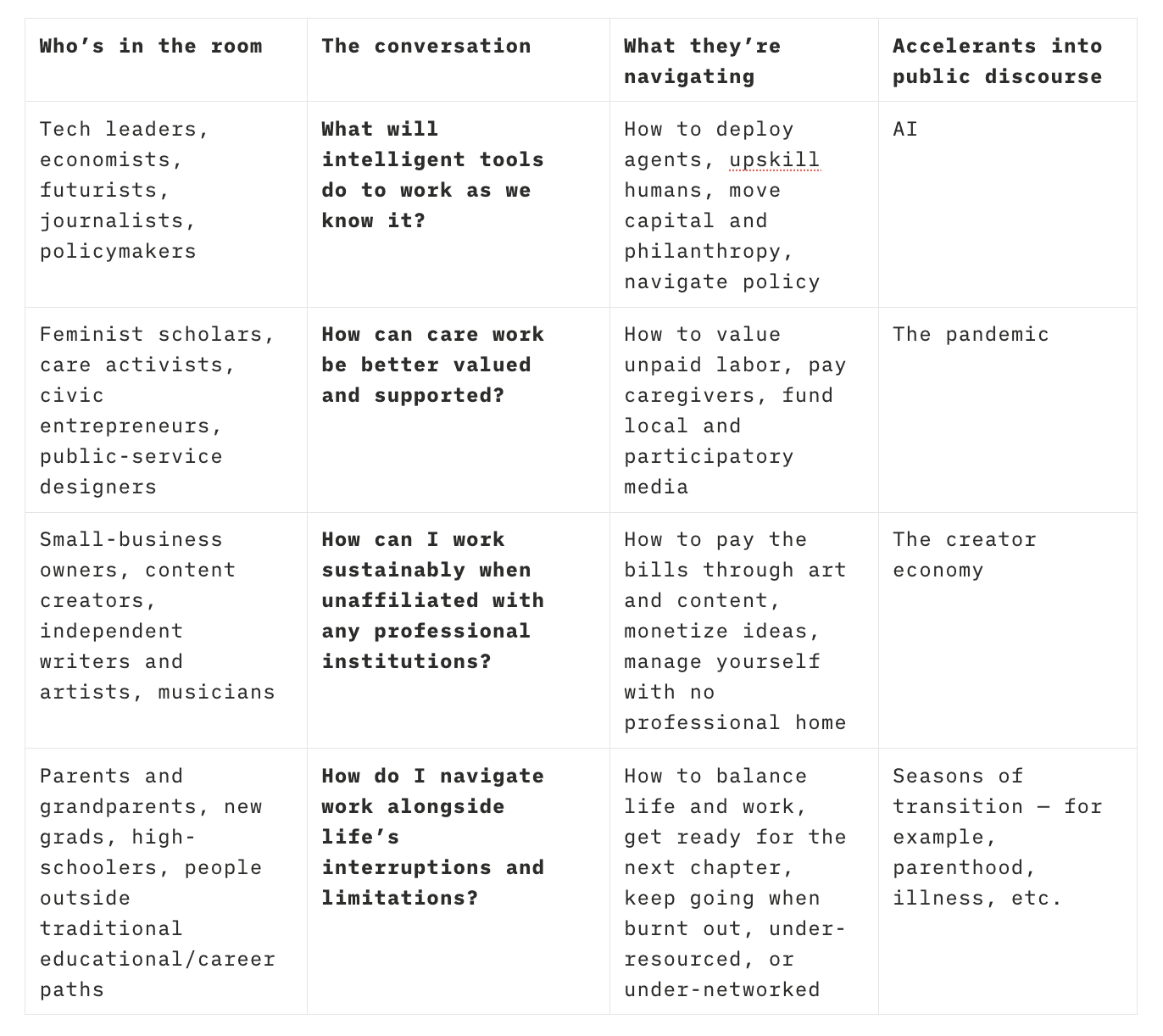
The future-of-work conversation is loud right now, and it’s full of serious people asking good questions about AI and jobs, like what gets automated, how people get retrained, and where the value and the money go. But I can’t help noticing that many of the underlying questions aren’t new. They’ve been alive for years in movements and research initiatives about care, independent work, education, disability, parenting, mutual aid, social infrastructure and more. They just haven’t always been framed as “the future of work.”
While AI has made questions about cognitive work (and, as robotics develops, many other forms of work) newly urgent, the pandemic did something similar for care, making visible questions about caregiving, dependency, and how we should approach our working lives.
Meanwhile, independent workers have been wrestling with questions about expertise, legitimacy, and making a living outside institutions for a long time and a lot of tooling has emerged in the last decade that makes it possible for independent creators to make good money.
And then you have the more acute moments of interrogation that take place during life’s inevitable transitions—parenthood, career transitions, illness, disability and a host of other planned and unplanned transitions in which we have to reckon seriously with our working lives.
These don’t look like the same conversation. But taken together, they make me wonder whether the future of work is already being designed in many different rooms and whether, because AI is so loud right now, we’re treating only one of those rooms as in charge of the future.
Here is my attempt at sketching it out.
It is, relatively speaking, low-hanging fruit to take a stack of job descriptions and hand them to autonomous agents. That’s a real engineering problem and smart people are solving it.
But it is not low-hanging fruit to figure out how work fits into the rest of life, and it seems we’re at an inflection point where that conversation needs to become just as loud as the conversation about the jobs that come next.
Work interacts with a person’s ability to be a primary caregiver, start a non-venture-backed business, or grapple with selfhood and livelihood (which are inextricable, particularly for younger generations) in a globalized society.
All of that depends on robust social infrastructure, a long-sought-after reckoning with our values as a society, and a much stronger education system that can address a plethora of literacies we’re only just beginning to discover. Our evolution to date and our technology to date are not especially well matched.
It feels like a fourth chapter in a series of questions I’ve been struggling with for years: who gets to be at the decision-making table when forms of expertise that used to belong to professions begin escaping into public life?
who gets to be a knowledge worker and isn’t it all of us? (2021)
mapping the grey zone between practice and profession (2025)
and now, who gets to design the future of work, and isn’t it all of us?
To be fair, there are already people working across these boundaries. But as a whole, these conversations still tend to evolve in separate rooms. I’m very curious what can happen if we can bring more of them together. If you’re working at these intersections or interested in experimenting with ways to try, please reach out :)
Jihii