
I recently received a press email from the Missouri School of Journalism about a new study on AI use by 18–24 year olds. 32% of 700 survey respondents said that AI makes it easier to understand complex topics they otherwise would not engage with. 43% said that even if AI explains something clearly, they still feel the need to question it.
Their takeaway was that among this group of users, AI is being used as a starting point for understanding difficult things, rather than replacing critical thinking—in other words, it lowers the barrier to entry for engaging with complex subjects and creates more space to apply and interpret that information.
I initially deleted the email because it didn’t feel that new or interesting to me, but the takeaway stayed on my mind because I believe it to be true in my own life: AI seems to be a starting point rather than a replacement for thinking. Which is both empowering and strange.
Today I want to unpack the strangeness through a few questions that keep showing up for me.
#1: If output is no longer a reliable signal of a person’s work, what is?
AI has given me access to skills I didn't previously have. Last month I used it to redo my website code and build a membership management system—things I would have previously needed to outsource. It felt magical, like I could build anything.
On the flip side, every week, more people who were not previously writers are entering the world of writing online with polished prose that is often heavily AI-assisted, writing on the same themes I do. I don't honestly feel threatened, but it's destabilizing… like a whole new population entered your hometown all at once, and you can't tell who was always there and who is new.
I asked my partner how it felt from his side, as a developer, to have non-coders now coding. Threatening? Disorienting? His answer was simply that this is why you have to do what others can't. I understood what he meant, but the question about how it feels remains. Do developers feel the same unease that writers do, or are they just relieved for shortcuts?
For me, the question that keeps showing up is: What is the thing that’s actually yours? In other words, if output is no longer a reliable signal of a person’s work, what is?
#2: What will it mean to feel capable without much friction?
Perhaps the strangest thing I’m noticing is that because there are no clear norms (or expectations, unless by an employer) to acknowledge the use of AI assistance, it feels like we are all walking around feeling more talented than we actually are.
Or maybe what I mean is: our abilities now feel both more real and less owned. I can code a little now. I can make things I could not make before. That is real.
But it is also real that I did not arrive there through the old path of practice, repetition, frustration, failure, fluency. Something about that changes the feeling of the skill—at least for me, in my body and in my sense of what I’ve actually earned. I can only liken it to getting your nutrition from a smoothie instead of food. No chewing and thus, poorer metabolizing.
The most useful thing I’ve read on this feeling was this piece in which Ezra Klein talks about what he saw in San Francisco recently that was different from his previous AI reporting trips. He saw that it had started to change people.
He writes:
You might think that A.I. types in Silicon Valley, flush with cash, are on top of the world right now. I found them notably insecure. They think the A.I. age has arrived and its winners and losers will be determined, in part, by speed of adoption. The argument is simple enough: The advantages of working atop an army of A.I. assistants and coders will compound over time, and to begin that process now is to launch yourself far ahead of your competition later. And so they are racing one another to fully integrate A.I. into their lives and into their companies. But that doesn’t just mean using A.I. It means making themselves legible to the A.I.
… Behind this drive is an experience of A.I. that many casual users have not yet had. An A.I. without deep knowledge of you is an upgrade, perhaps, over Google search. An A.I. with deep knowledge of you feels like something else entirely.
I’ve also noticed how much people are changing (myself included).
There are those who adopted AI early and don’t seem to realize they’ve changed—they feel and act fluent, and have confidence that was developed without friction. It’s kind of like we all have speechwriters now.
There are those who are just adopting now and don’t realize that others can tell they’ve used AI, with its uncanny polish and leaps in connection.
And in the messy middle of it all, we are beginning to notice AI in the wild and hold people accountable, sometimes in accusatory ways.
#3: What happens to self-trust when thinking becomes assistive?
One analysis of AI adoption by industry offers this summary of who has adopted AI so far and why:
The industries that have adopted AI with fervor so far have a few similarities: they are text-based, involve rote and repetitive work, have natural human-in-the-loop involvement to inject human judgment, limited regulation, and have clearly verifiable end outputs (e.g., code that runs, a resolved support ticket). Many industries don’t have these properties. They either deal with the physical world, rely heavily on interpersonal relationships, have clear coordination costs across many stakeholders, impose regulatory or compliance hurdles, or lack verifiable results.
But for those using it in vaguer settings, I keep coming back to a question about what kind of relationship AI is creating between us and our own minds.
Klein unpacks this using a distinction researchers make between “cognitive offloading” and “cognitive surrender”: the difference between handing over a discrete task and handing over judgment itself.
He writes:
Cognitive offloading comes when you shift a discrete task over to a tool like a calculator; cognitive surrender comes when, as Steven Shaw and Gideon Nave of the University of Pennsylvania put it, “the user relinquishes cognitive control and adopts the A.I.’s judgment as their own.” In practice, I wonder whether this distinction is so clean: My use of calculators has surely atrophied my math skills, as my use of mapping services has allowed my (already poor) sense of direction to diminish further.
I appreciated the analogy because it made something click. These puffy chests we’re walking around with—I can code! I can write!—do we need to acknowledge the second brains behind them?
To use his metaphors: do I need to acknowledge that I was able to get to your house because of the live mapping software that helped me, rather than my great sense of direction? Do I need to tell the nanny I know how much to pay her because I can do great math or because a calculator in my phone did it for me?
Maybe not. We do not narrate every assistive technology behind our competence. Most of us do not announce that GPS got us somewhere, or spellcheck cleaned up the email, or the search bar saved us from memory. And yet AI feels different to me… because it assists judgment, not just tasks.
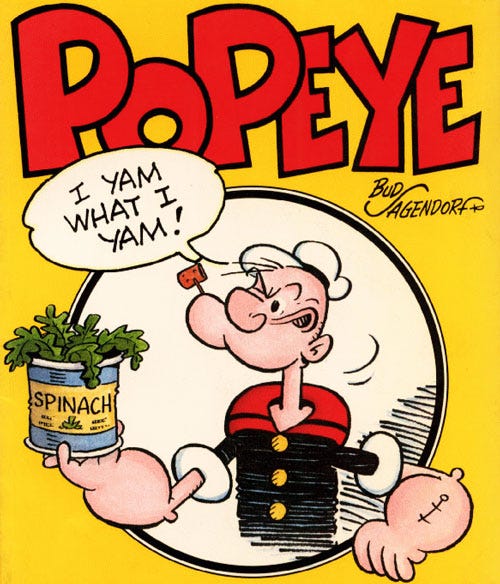
It is helping us do things, yes, but it is also helping us feel like the kind of person who can do them. As if consuming a can of spinach could give us instantaneous muscles.
Klein goes on:
I’ve been an editor for 15 years now. Recognizing a bad idea beneath good writing — even in myself — is part of my job. But what would it mean to grow up with that kind of companion? What would it mean to have your every adolescent intuition turned into persuasive prose? What is lost in not having to do the work to build out our intuitions ourselves.
Very early on in my experiments with chat, I found that using AI for feedback was eroding my sense of self-trust. And yet developing self-trust is one of the most important tasks of being human.
Throughout my teens and 20s, I outsourced my self-trust to friends. I imagine you did, too. It’s a major phase of coming of age. I called them to process most everything in life, I couldn’t believe in my own opinion or accept my own desires without needing to check myself against the group.
Eventually, I was able to develop this skill of self-trust. It took remarkable work. I’m grateful, because I notice the tendency very easily now, when I am seeking validation outside of myself. But what of those of us who don’t? Who are still 22 years old and wanting to feel that they are acceptable, that they belong?
In this sense, AI is not a new problem. It is allowing us to indulge differently in a very old one—more quickly, more often. But when you do something more quickly and more often, it becomes a habit before you’ve had time to question it.
And so, perhaps the very normal tensions of being a human being who does not feel acceptable yet, get twisted into something far more difficult to confront. This is my main worry. I’ve seen it happen with social media and its echo chambers. And I think, if we are heading toward a world in which the skills of making are being demoted to tasks that can be taken care of by widely available assistive technologies, something fundamental seems at stake.
Put another way: on the one hand, the possibilities and playing fields are finally leveling. But on the other, we can outsource our way through things that feel like they are hard for a reason. For example, as a mother, I could rely on tons of expert-generated parenting knowledge or I can trust my gut, which contains not only my survival instincts but also generations of evolved wisdom. As I’ve written before about outsourcing processing to AI:
In each case, the thing got done. But I remember almost nothing about how it felt. The dish got cooked but I couldn’t repeat it without instructions. The medical information was processed but something still sits in my chest. The project moved forward but I never had to sit with the nerves so I’m not actually sure I believe in it yet.
In other words, what you don’t see in these examples, is my body having to move through friction. Everything is just… doable, done, efficient.
If calculators atrophied math and maps atrophied direction, will AI-generated writing and information atrophy self-trust?
Intuition, I think, is a relationship with yourself built through friction—sitting with uncertainty, being wrong, feeling different, being judged, and learning to trust your own voice anyway. What happens if we don’t know how to trust our own voice anymore?
Put together, here we are:
#1: If output is no longer a reliable signal of a person’s work, what is?
#2: What will it mean to feel capable without much friction?
#3: What happens to self-trust when thinking becomes assistive?
There is a part of me that could argue that these doors we’re opening are good ones—that output shouldn’t be the only signal of a person’s work and perhaps this is the key to ending productivity culture; that confidence without friction will allow marginalized groups to finally take center stage; that assistive thinking is the key to overcoming demoralizing impostor syndrome.
But 2.5 years into AI life in a world filled with leaders raised on the myths of individualism, I’m a little more cautious than optimistic.
Still playing, though, and practicing trusting myself as I do.
Jihii
Loved this!! Thanks for putting into words some things I've been mulling over re: my own AI use and its effect on my own self-percept