
#106: what is reading for?
a menu of ways to engage with books, in conversation with Christie George

Good morning,
My relationship with reading has been changing over the last few years. In childhood, I was a voracious reader of fiction. In college, I lost steam when it felt like class assignments outpaced my ability to metabolize what I was reading and my social world outsized my capacity to nurture relationships with fictional protagonists.
In adulthood, reading neatly relegated itself into two streams: books for work, usually nonfiction, that helped me do research, and books for entertainment, which increasingly lost their place in line to streaming television and social video streams.
I began to reach for intentional reading only in tenuous moments: to process life, to understand something complex adulthood had not prepared me for, and, more recently, to make friends.
A few months ago, I had a lovely conversation with Christie George, author of a peculiar artifact whose making opened a creative journey for her that’s now lead to many workshops, events, conversations (and last year, this podcast with the two of us!)
I thought she would be the perfect person with whom to explore this conversation I’ve been having with myself about reading. Below, you’ll find excerpts from our chat woven together with my own thinking.
First, some context on her artifact, The Emergency was Curiosity.
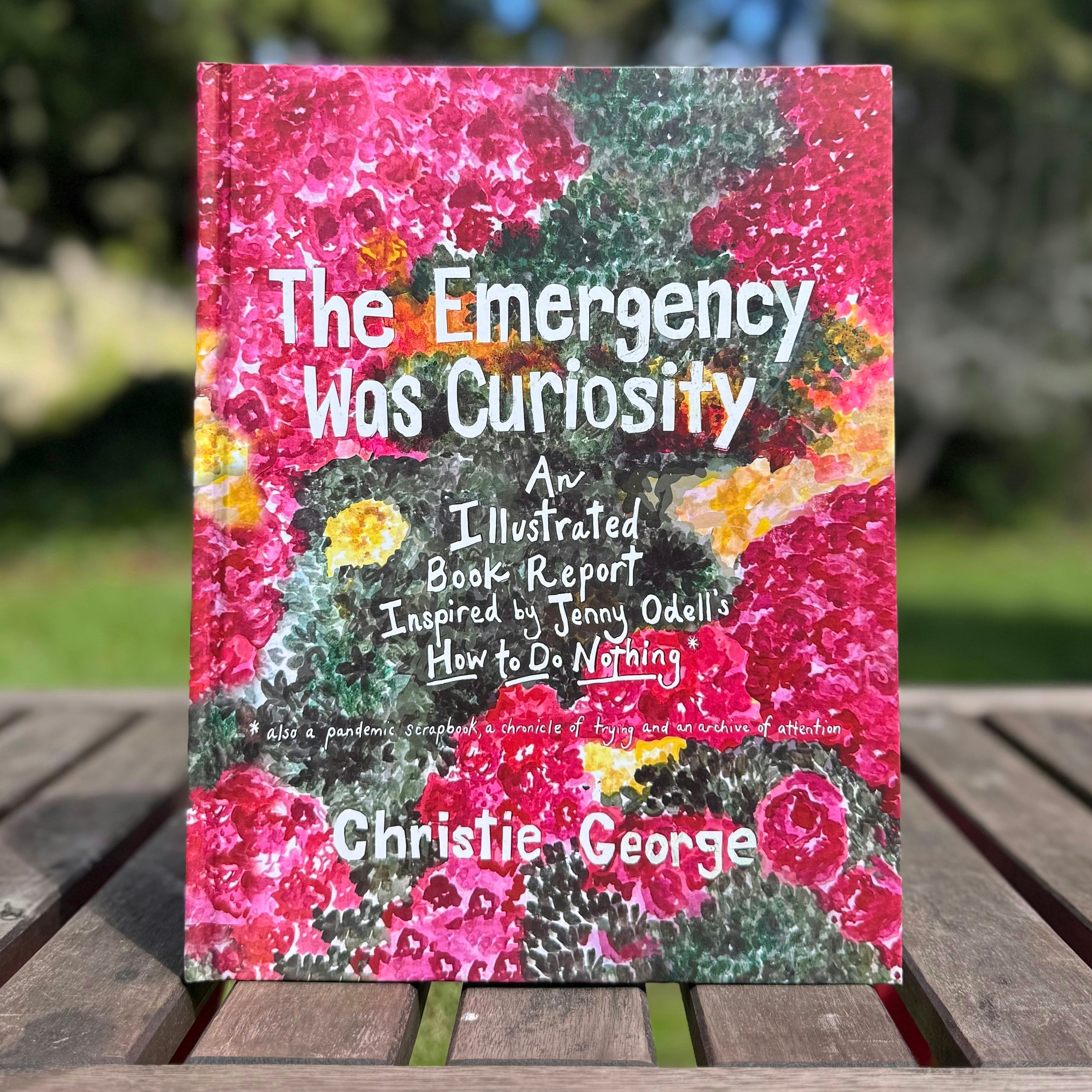
Originally inspired by Jenny Odell’s book, How to Do Nothing, in the early pandemic days, Christie found herself reading closely and copying quotes by hand that she wanted to remember.
And then that just got out of hand and I started doodling and drawing and writing essays about the ways the ideas in the book were relevant, increasingly in my own life and in that cultural moment.
What I didn’t know is that this type of artifact is actually called a commonplace book, dating back to the 17th century, when it was common to collect information from here and there, not read in a linear format and use these notes to make sense of the world. In Christie’s case, she came to this practice from an unlikely place; her career began in independent film distribution and eventually funding progressive media and technology companies.
I think the real departure for me was sort of in the permission to work on something as substantial as this without a goal or deadline or audience or boss or reason. All the writing that I have done in my career has been for a purpose: either to convince someone of something, or promote something or advocate for something.
As the project grew bigger and took more and more of her time, Christie joined a creative group with a few other people, imagining she would stay in it long enough to get one round of feedback from others, as well as offer others feedback on their work. She intended to print three copies of the book report: one for herself, one for her parents and one for Jenny Odell.
I was thinking it was this time-boxed thing that coincided with the pandemic and then it would be over and we would move onto real life.
Instead, Christie kept working on it and decided to also ask some close friends for feedback on her draft. One friend passed it onto another and while Christie was nervous about a stranger reading what felt like a self-indulgent project, something clicked.
She lived in New Zealand and I had never met her but she turned out to be the most comprehending reader of the project. I say comprehending, specifically, because she understood the point of the project more deeply than I ever did in my own searching and questioning the whole time I was working on it: why am I continuing to work on this thing? She was already on the other side in her own practice and journey.
She wrote a 17 page book report about Christie’s book report and sent it to her in a Google Doc.
I was expecting feedback and edits but then I got this whole other thing that was like all of her own experiences, both reading Jenny’s book, her reactions to my reactions to Jenny’s book and all of the rabbit holes that she went down reading my project. And I was just like, wait, is this what happens when you share your work with people?
That motivated Christie to share the project more widely so she self-funded printing 500 copies and make day-by-day efforts to launch it: through an exhibition, talks, workshops, and lots of hand-by-hand selling to bookstores. (You can get it here!)
Hearing her talk made me imagine a tiny cartoon girl, enlivened by a maddening curiosity who creates this inexplicable THING! And then thinks to herself, “I did this thing! Wait, how dare I? Who am I to do this thing?”
I’ve had this very journey countless times before I chose to invest professionally into a creative career. In this sense, both writing and reading have lived in the margins of my life, punctuating heavy transitions, extrapolating difficult to understand feelings, birthing random “things” that come from nowhere when I am suddenly possessed one afternoon and then… ah, catharsis, insight.
As we spoke, here are a few things I started to think.
What if reading differently is a way into art for people who don’t identify as artists?
If you actually want to move your life in the direction of having a sustained creative practice, professional or not, you have to take concrete steps. Often, I see people freeze because they aren’t sure what they want to make. What if reading can be one of the first steps toward yourself?
What if processing life through reading is uniquely human and urgent in the age of AI?
I’ve been noticing more and more how AI doesn’t allow me to metabolize information before reaching understanding. I get the facts or the insight explained perfectly, but nothing has time to reach my body, where information actually lives. What if reading in a new, generative way, is necessary in this age, not to “get the point” of the book but to have the experience itself?
What if sharing reading with each other is as important as reading itself?
My first social experience after moving to San Francisco was joining a book club with friends-of-friends who wanted a social circle. We stayed together for a long while and I read and discussed much more fiction than I normally read and it truly pushed me past the boundaries of my intellectual and social comfort zones in the best of ways. That became a craving and then a habit, and since then, I find reading together being an integral part of new friendship and communities across the board: Buddhist friends, writer friends, mom friends, art friends, family.
So, I asked Christie, can we try to jot some some ways of reading, a menu if you will? Here’s my draft based on our brainstorming.
How to engage with text in a generative, life-connected way:
Write a book report. Pick up a book you want to engage deeply and slowly with, and go for it. You can do it for yourself or even gift it to a friend or family member who will never read the book but may love your notes.
Start your own commonplace book. Braid all kinds of things in it. Make connections. Make sense of life through your own private curation.
Write a book in the margins of another book. I haven’t made a book report in a long while, but I do secretly write new books in the margins of other books. Sometimes, while reading, I just can’t stop the process. Then, I transcribe my writing onto a blank document but I preserve the form: my writing is in the margins of the page. The center is blank. It’s weird, feels like poetry, I never share these, and I love it.
Schedule a bookclub that suits your intentions.
I’ve seen so many cool kinds:bookclubs on a theme (motherhood, cookbooks where everyone cooks 1 dish from the book)
bookclubs that run monthly (rotate who picks and vote) for the social connection
bookclubs that simply meet 1 time to discuss 1 book that feels worth discussing
groupchats to discuss the book as you’re reading them because sometimes you just want to dump your live thoughts to someone else having the same experience
Write a fan letter. Or find another way to engage with the writer of a book you loved. Christie does this and I find it so awesome. Why don’t I write to authors more often?
Build a constellation of books on a theme to help yourself understand something. I did this, for example, when I was dealing with the choice to become a parent, and read my way through my feelings.
Pick up a book explicitly to help you process life or help someone else do so. I once interviewed two friends who would recommend books to each other to navigate life experiences and eventually started offering this service (bibliotherapy) to others. How brilliant! Ask a voracious reader you trust for a suggestion on what to read to process something: a transition, a question, grief, curiosity, fear, a mood.
If you do none of the above, I’ll leave you with one more idea that Christie sparked when she said:
I feel like I mark time now by the books that I’m reading. If you gave me a date, like, April 2024, I wouldn’t really be able to tell you anything, but if you gave me the title of a book, I could tell you when and where I was while I was reading it. Both literally and in my head or in my life.
I completely agree. Do you?
If you were to jot down what was happening in your life during the last 3 books you read and why you even picked them up, what might emerge?
Happy Monday,
Jihii
Your piece reminds me of this conversation I've been having with my tween-turned-teen: on the difference between reading fiction and watching a complex and well-executed TV series. The thing I realised is that reading (unlike TV) does its magic when you're AWAY from the pages. When the characters in the books are in your head and they're doing things to you.
In any case, the first book I wanted to live with in the way you've described Christie George does was Travels with Herodotus by Ryszard Kapuściński. The next book I want to do this with (and I may yet do it) is the Dasakumaracharita by Dandin. Both are translations to English!
Great framing of reading as metabolizing vs just consuming info. The commonplace book idea feels underrated in an age where everyone highlights digitaly but rarely revisits. I startd keeping handwritten notes next to books after noticing AI summaries left me feeling like I "knew" something without actually understanding it, that gap you described hits hard.